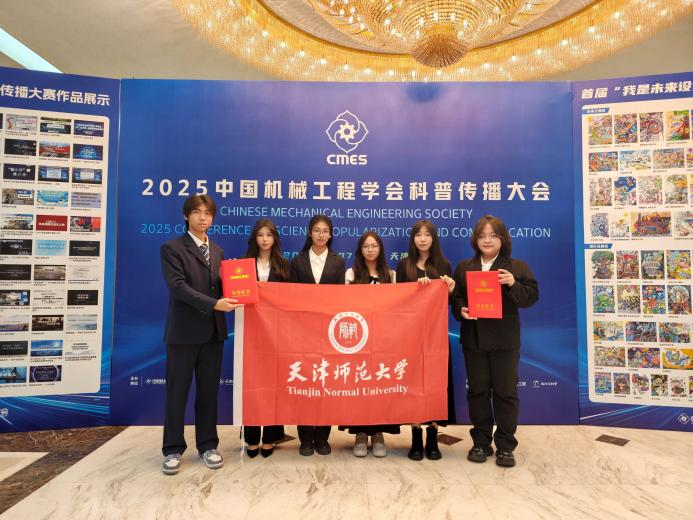
The 6th Competition of Yunshuo Xinkeji Science Popularization and Communication, along with the 2025 Conference on Science Popularization and Communication, organized by the Chinese Mechanical Engineering Society (CMES), recently concluded in Tianjin. An interdisciplinary innovation team composed of students from the School of Electronics and Communication Engineering, the School of Artificial Intelligence, and the School of Journalism and Communication at Tianjin Normal University (TNU) secured one national first prize and one national third prize in the competition.
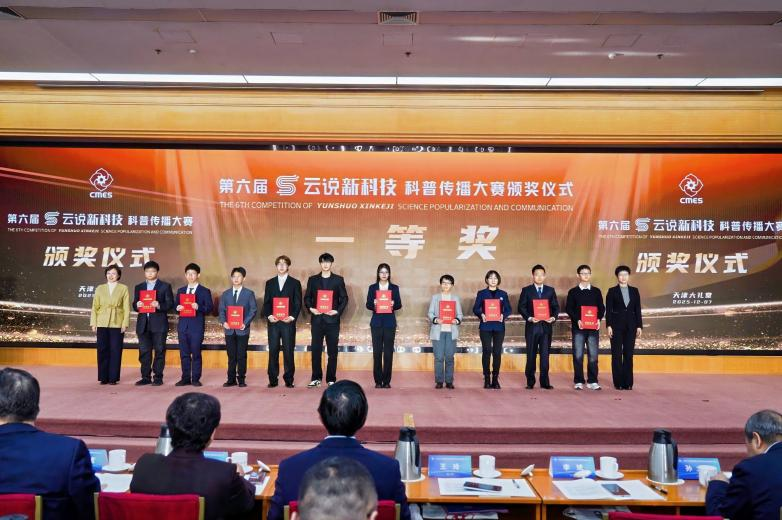
As a national science popularization event, this year's competition attracted widespread participation from universities, enterprises, and research institutes across the country. After rigorous selections, 182 outstanding works advanced to the national finals. During the final defense session, the TNU team not only presented core scientific principles but alsodemystified complex technologies, making them to a broad audience.
The work awarded the national first prize, titled "Brain-Controlled Exoskeleton: Letting Thoughts Move the World," was submitted by TNU's Artificial Intelligence Innovation Education and Popularization Base. The work demystifies "mind control" from an accessible perspective—enabling individuals with mobility challenges to stand again and granting ordinary people "superpowers." The team members were Gao Zhan, Zhang Jiaxin, Gao Yan, Liu Ruohan, and Zhang Yuhan. The work awarded the national third prize, "When Machines Learn to 'Understand People': The Evolution of Human Factors Engineering in Industrial HMI Design," analyzes how technology, through human-centric design, makes industrial production safer and more efficient. The team members were Li Ranran, Dong Yinghui, Gong Chang, Zhai Yiting, and Hu Jiaying.
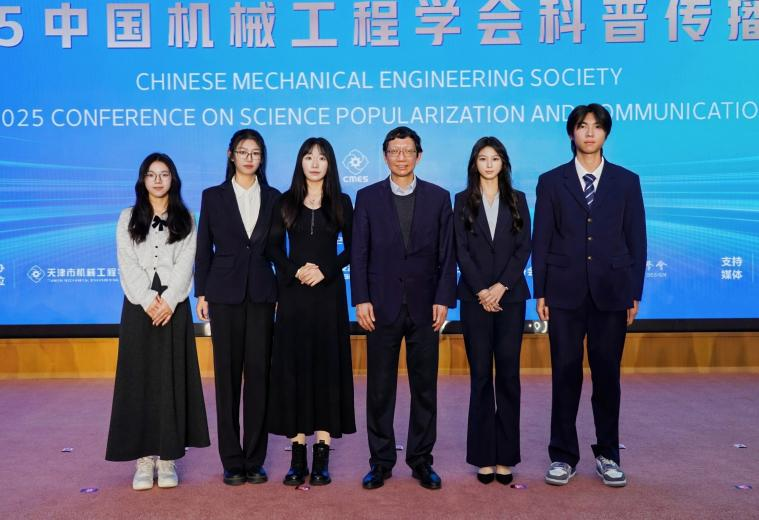
Following the awards ceremony, Professor Tu Shandong, Academician of the Chinese Academy of Engineering, took a group photo with the winning TNU team and commended them for their scientific literacy and innovative spirit.
The success was supported by the robust foundation of TNU's national-level science education base—the Innovation Education and Popularization Base of the School of Artificial Intelligence. For a long time, the base has served as a crucial platform for incubating students' innovative thinking and enhancing their scientific literacy by providing practical platforms, integrating high-quality resources, and offering professional guidance.
TNU will continue to adhere to the fundamental task of fostering virtue through education, deepen educational and teaching reforms, further refine its science popularization and innovation practice systems, and cultivate more outstanding talent equipped with scientific literacy, an innovative spirit, and a sense of social responsibility, contributing TNU's strength to building a leading nation in science and technology.
By He Jierui



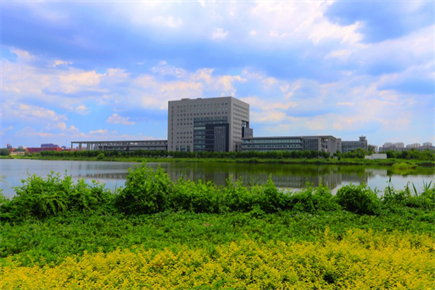 TNU is the only one of its kind in Tianjin that focuses on training high-quality teachers for basic education. It has rich educational resources, excellent facilities and equipment, a strong humanistic spirit, a beautiful and elegant environment.
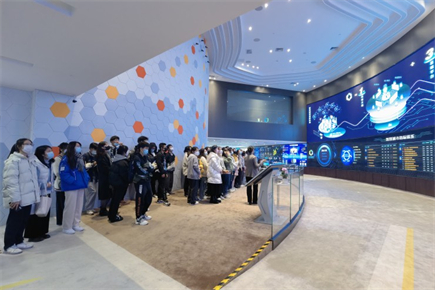 TNU has a complete range of disciplines and has outstanding advantages in its majors and has made significant achievements in cultivating talents.
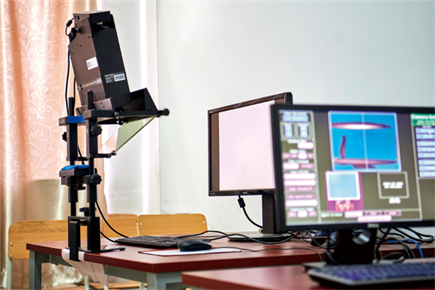 TNU has a strong research capacity with abundant high-quality research practice bases. They have been approved for over 300 national-level projects and won numerous national awards for outstanding achievements.
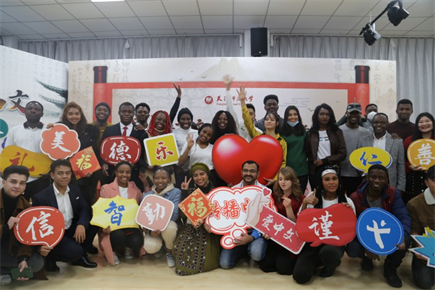 Read all of our latest news and opinion articles, and find out about our upcoming events which can enrich your life at TNU.
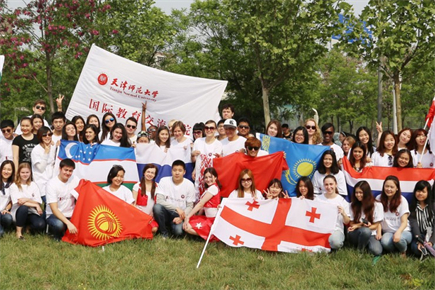 TNU adheres to open education and conducts extensive international exchanges and cooperation. It proactively connects the Belt and Road Initiative, and actively serves the national strategy of "Chinese culture going global".
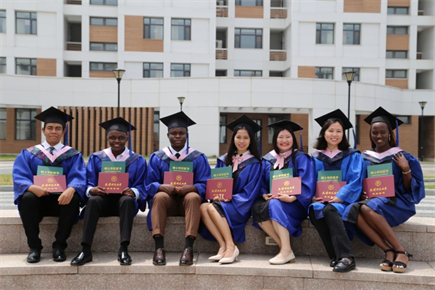 TNU cooperates with countries including Russia, Japan, and South Korea to build four Sino-foreign cooperative education projects, and its scale of international student training ranks among the top in Tianjin.
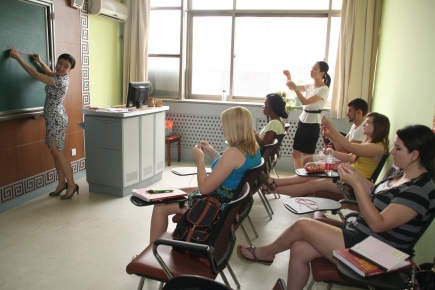 TNU adheres to open education and conducts extensive international exchanges and cooperation. It proactively connects the Belt and Road Initiative.