A paper titled "Direct radiative forcing of light-absorbing carbonaceous aerosol and the influencing factors over China," co-authored by Professor Chen Li and Master's student Yang Shuangqin from the Faculty of Geography at Tianjin Normal University (TNU), has been published in the journal Atmospheric Chemistry and Physics.
Black carbon (BC) and brown carbon (BrC), as the primary light-absorbing carbonaceous aerosols (LACs), significantly influence climate change by absorbing and scattering radiation. This study employed the GEOS-Chem model coupled with a rapid radiative transfer model for general circulation models to evaluate the properties and direct radiative forcing (DRF) of LACs over China. Primary BrC (Pri-BrC) and secondary BrC (Sec-BrC) from organic carbon were separated and simulated as independent tracers. The research updated anthropogenic LACs emissions data and refractive index parameters for China, and applied principal component analysis to investigate the influence of LACs properties and atmospheric variables on their DRF.
Results indicate that BC contributes to warming at the top of the atmosphere, whereas both Pri-BrC and Sec-BrC induce cooling effects. At the surface, all three contribute to surface cooling; however, within the atmospheric column, they cause atmospheric heating with intensities of 1.848 ± 1.098, 0.146 ± 0.079, and 0.022 ± 0.008 W/m² for BC, Pri-BrC, and Sec-BrC, respectively. The shortwave DRF of BC and Pri-BrC in the atmosphere shows positive correlations with their concentrations, aerosol optical depth (AOD), and absorbing aerosol optical depth (AAOD), while exhibiting negative correlations with single-scattering albedo, surface albedo, and ozone concentration in most regions. The longwave DRF of LACs at the surface is negatively correlated with water vapor content in most areas. Due to the combined effects of high LAC concentrations, high AOD and AAOD values, and low surface albedo and ozone concentrations, central China exhibits the strongest atmospheric warming effect, followed by eastern China. This study deepens the understanding of the climatic effect mechanisms of LACs.
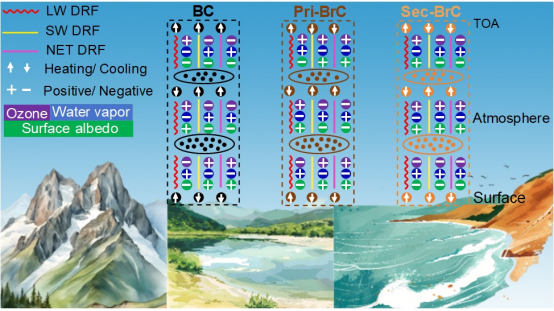
Figure 1. Radiative forcing of light-absorbing carbonaceous aerosols and influencing factors.
Yang Shuangqin is the first author of the paper, with Chen Li serving as the corresponding author. TNU is the primary affiliation. The research was supported by the National Natural Science Foundation of China (42477106).
Article link: https://doi.org/10.5194/acp-25-9335-2025
By He Jierui



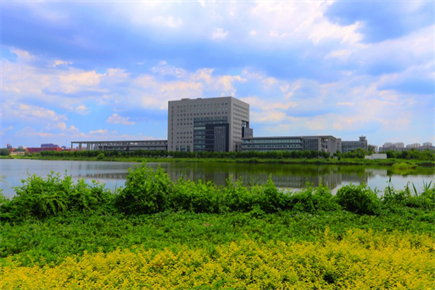 TNU is the only one of its kind in Tianjin that focuses on training high-quality teachers for basic education. It has rich educational resources, excellent facilities and equipment, a strong humanistic spirit, a beautiful and elegant environment.
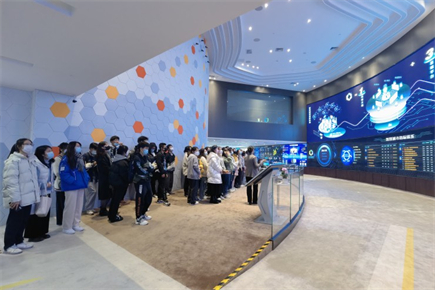 TNU has a complete range of disciplines and has outstanding advantages in its majors and has made significant achievements in cultivating talents.
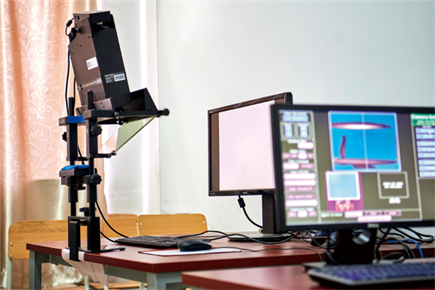 TNU has a strong research capacity with abundant high-quality research practice bases. They have been approved for over 300 national-level projects and won numerous national awards for outstanding achievements.
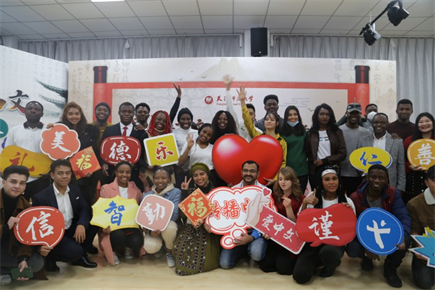 Read all of our latest news and opinion articles, and find out about our upcoming events which can enrich your life at TNU.
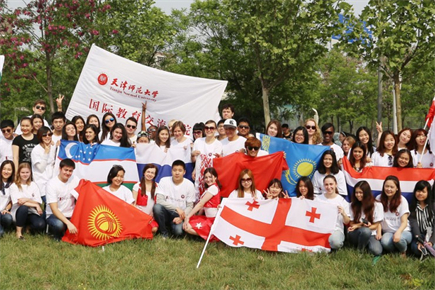 TNU adheres to open education and conducts extensive international exchanges and cooperation. It proactively connects the Belt and Road Initiative, and actively serves the national strategy of "Chinese culture going global".
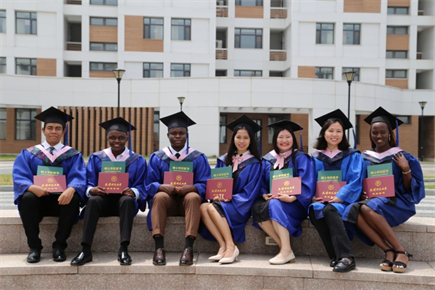 TNU cooperates with countries including Russia, Japan, and South Korea to build four Sino-foreign cooperative education projects, and its scale of international student training ranks among the top in Tianjin.
 TNU adheres to open education and conducts extensive international exchanges and cooperation. It proactively connects the Belt and Road Initiative.